-
Heavy Equipment
-
Motorgrader
Pre-inspection check list & Preventative
Maintenance Tips
Walk Around Inspection of Motor Grader Video
Operating Techniques
Grading a Flat Bottom Ditch Video
Cutting a V-Ditch Video
-
Gradall
Maintenance Tips
-
Wheel Loader
Maintenance Tips
Pre-inspection check list & Preventative Maintenance Tips
Operating Techniques
Loading a Dump Truck Video
-
Dump Truck
Maintenance Tips
Operating Techniques
Dump Truck Pre-Inspection Video
-
Sweeper
Maintenance Tips
-
Backhoe
Maintenance Tips
-
Motorgrader
-
Work Zones
-
Flagging
Flagging Guide
PPE for Work Zones
(Apparel)Section 6C.05 High-Visibility Safety Apparel
Standard:
01For daytime and nighttime activity, all workers, including emergency responders, within the right-of-way who are within the TTC zone shall wear high-visibility safety apparel that meets the Performance Class 2 or 3 requirements of the ANSI/ISEA 107–2004...
02The apparel background (outer) material color shall be fluorescent orange-red, fluorescent yellow-green, or a combination of the two as defined in the ANSI standard. The retroreflective material shall be orange, yellow, white, silver, yellow-green, or a fluorescent version of these colors.
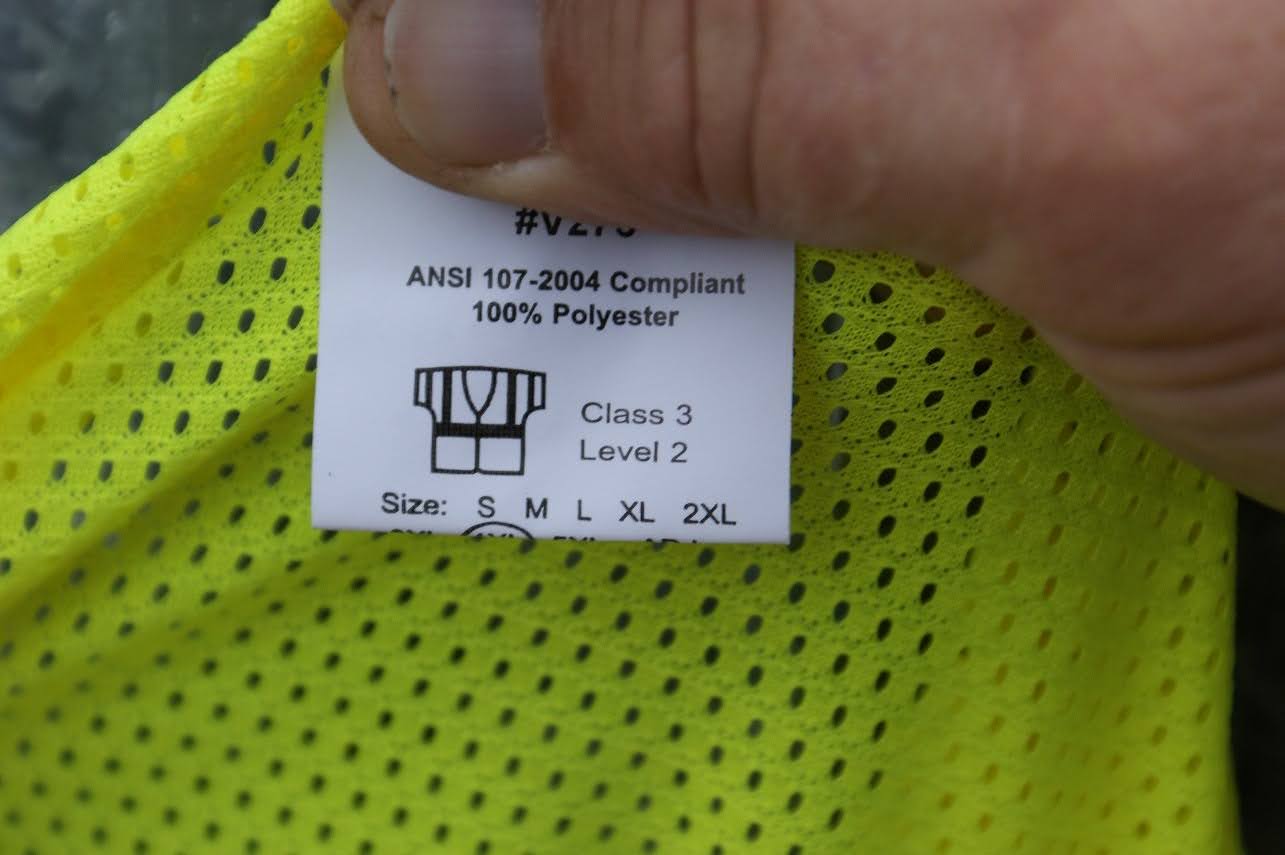
6C.05 Always make sure the safety apparel is labeled to show it meets the ANSI/ISEA 107-2004 requirements. Flaggers should also wear:
- Hard hat meeting ANSI Standard Z89.1986
- Safety footwear
- Eye protection
- Hand protection
PPE for Flaggers
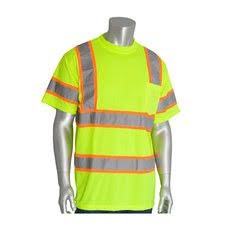
(High-Visibility Safety Apparel)01For daytime and nighttime activity, all workers…who are within the TTC zone shall wear high-visibility safety apparel that meets the Performance Class 2 or 3 requirements of the ANSI/ISEA 107–2015...
 02
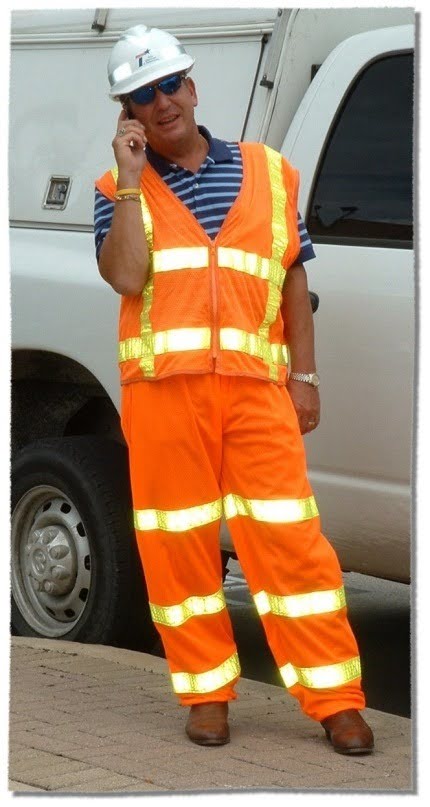
02The apparel background (outer) material color shall be fluorescent orange-red, fluorescent yellow-green, or a combination of the two as defined in the ANSI standard. The retroreflective material shall be orange, yellow, white, silver, yellow-green, or a fluorescent version of these colors.
07For flagger wear during nighttime activity, high-visibility safety apparel that meets the Performance Class 3 requirements of the ANSI/ISEA 107–2015... should be worn.
-
Temporary Traffic Control
Typical Applications
TA_11 Lane Closure on 2 lane road low volume
TA_12 Lane Closure Using Traffic Signal
TA_13 Temporary Road Closure
TA_15 Work in Center of Low Volume Road
TA_16 Surveying Along Centerline of Low Volume Road
TA_17 Mobile Operations on 2 Lane Road
TA_18 Lane Closure on Minor Street
TA_19 Detour for One Travel Direction
TA_20 Detour for Closed Street
TA_21 Intersection Lane Closure on Near Side
TA_22 Intersection Right Hand Lane Closure on Far Side
TA_23 Intersection Left Hand Lane Closure on Far Side
TA_24 Intersection Half Road Closure on Far Side
TA_25 Intersection Multiple Lane Closures
TA_26 Intersection Center Closure
TA_27 Intersection Closure at Side of Intersection
TA_28 Sidewalk Detour
TA_29 Crosswalk Pedestrian Detours
TA_30 Interior Lane Closure Multi Lane Street
TA_31 Lane Closure on Street with Uneven Directional Volume
TA_32 Half Road Closure on Multi Lane_High Speed Highway
TA_33 Stationary Lane Closure on Divided Highway
TA_34 Lane Closure with Temp Traffic Barrier
TA_35 Mobile Operation on Multi Lane Road
TA_36 Lane Shift on Freeway
TA_37 Double Lane Closure on Freeway
TA_39 Median Crossover on Freeway
TA_40 Median Crossover for Entrance Ramp
TA_41 Median Crossover for Exit Ramp
TA_42 Work in Vicinity of Exit Ramp
TA_43 Partial Exit Ramp Closure
Traffic Control Plans
TCP1-1
TCP2-1
TCP3-1
TCP5-1
TCP6-1
TCP7-1
TCPWS-16
-
Traffic Control Devices
Cones
- All channelizing devices shall be crashworthy.
- Cones used on each project should be of the same size and shape.
- Cones should be kept clean, visible, and properly positioned at all times.
- Damaged cones or cones that have lost a significant amount of retroreflectivity and effectiveness shall be replaced.
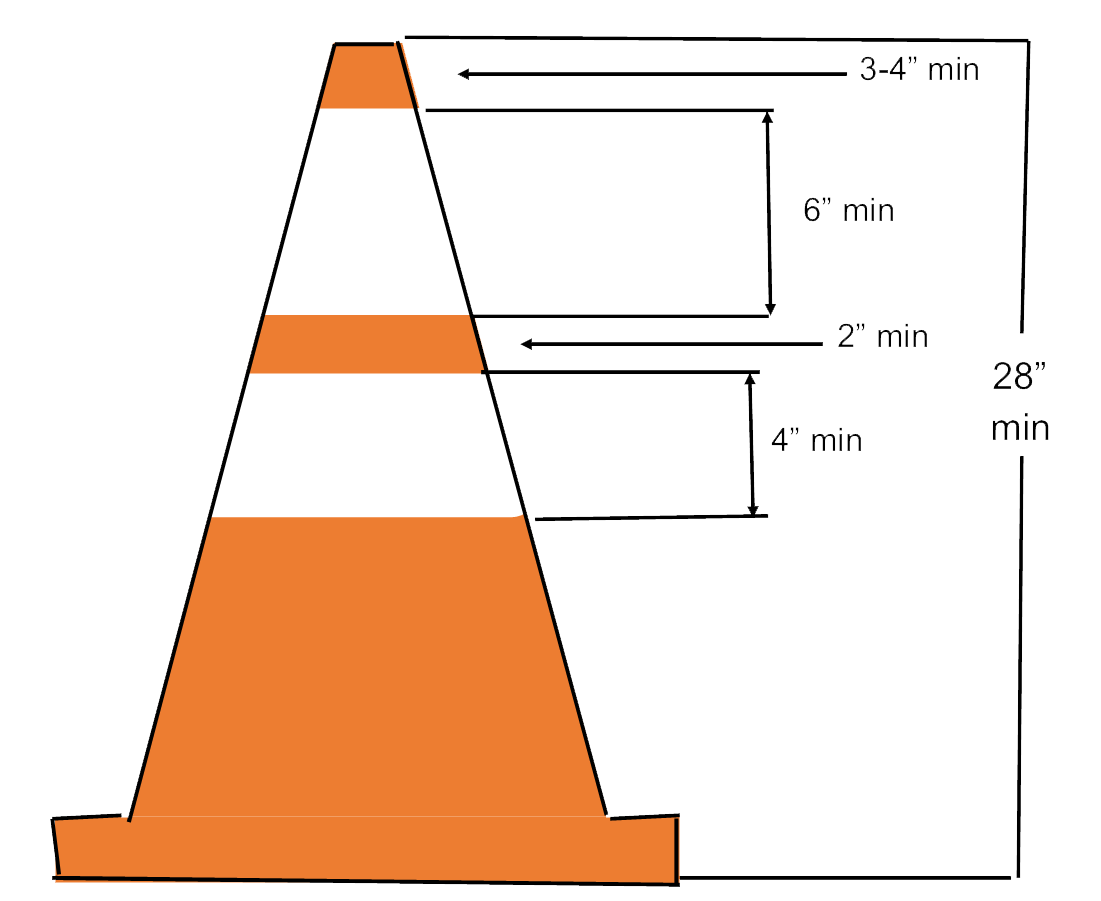
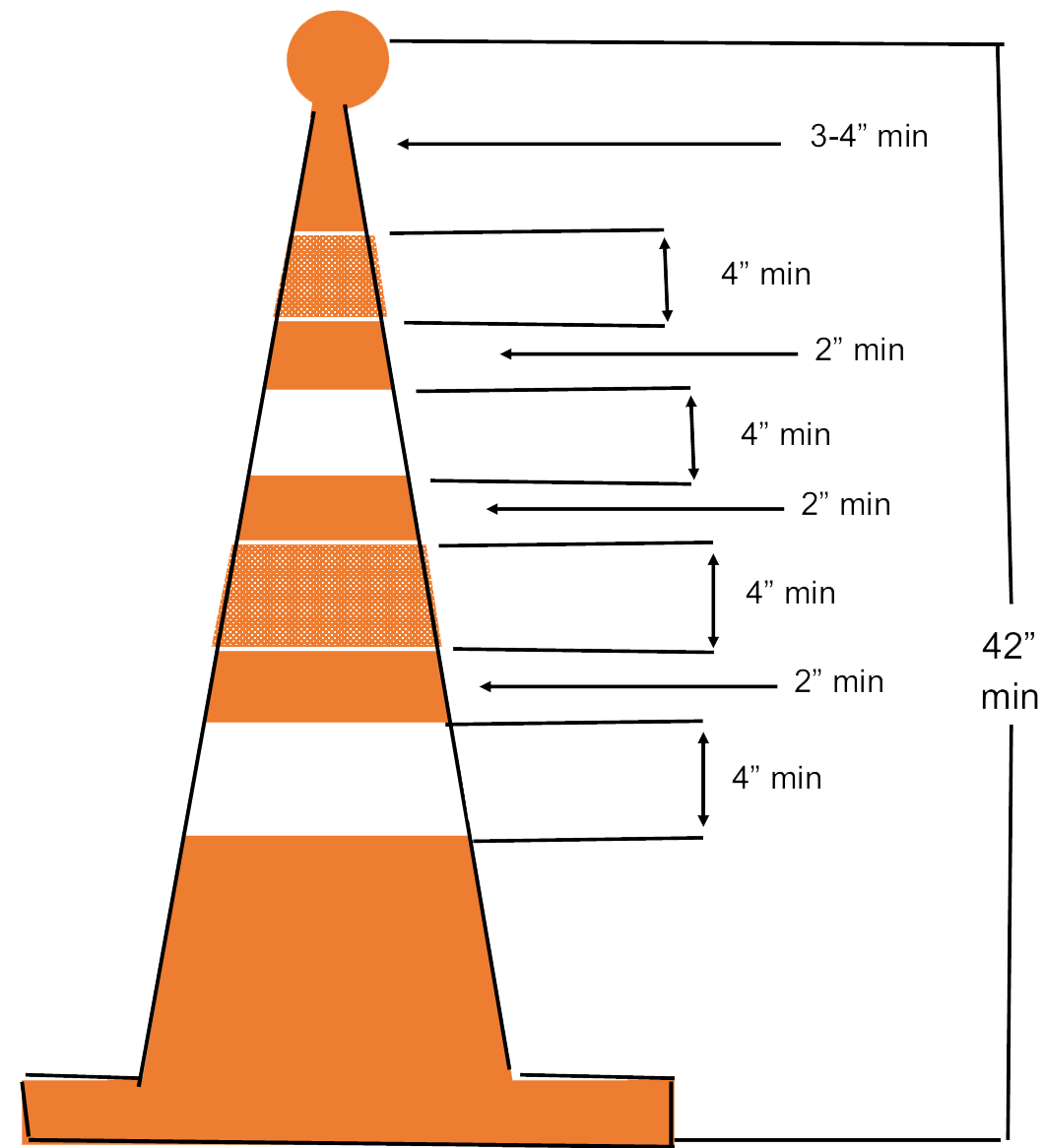
- Cones used at night shall have white or white and orange reflective bands as shown below. Reflective bands shall have a smooth, sealed outer surface and meet Department requirements.
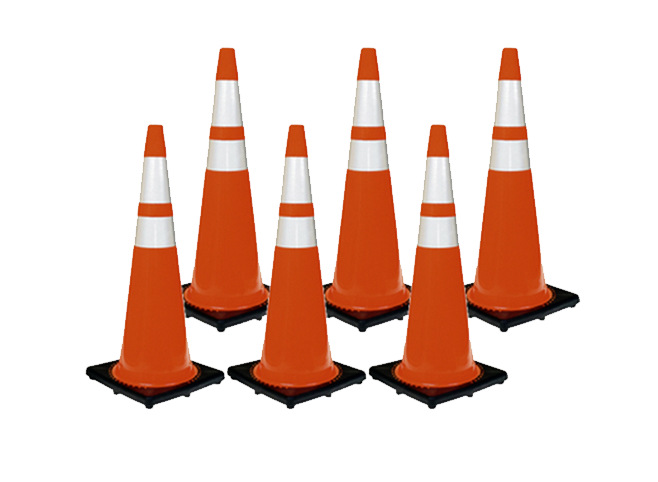
28" Cones
- Generally suitable for short duration and short-term stationary work. Not to be used on intermediate or long-term stationary work unless personnel are on-site to maintain them in proper upright position.
- Shall have a minimum weight of 9.5 lbs.
- 28" cones are the minimum height required for use on freeways and high-speed highways or at night on all highways.
42" Cones
- Suitable for all duration work zone durations.
- Shall have a minimum weight of 30 lbs. including base.
- May have a handle or loop extending up to 8" above the minimum height shown to aid in retrieving the device.
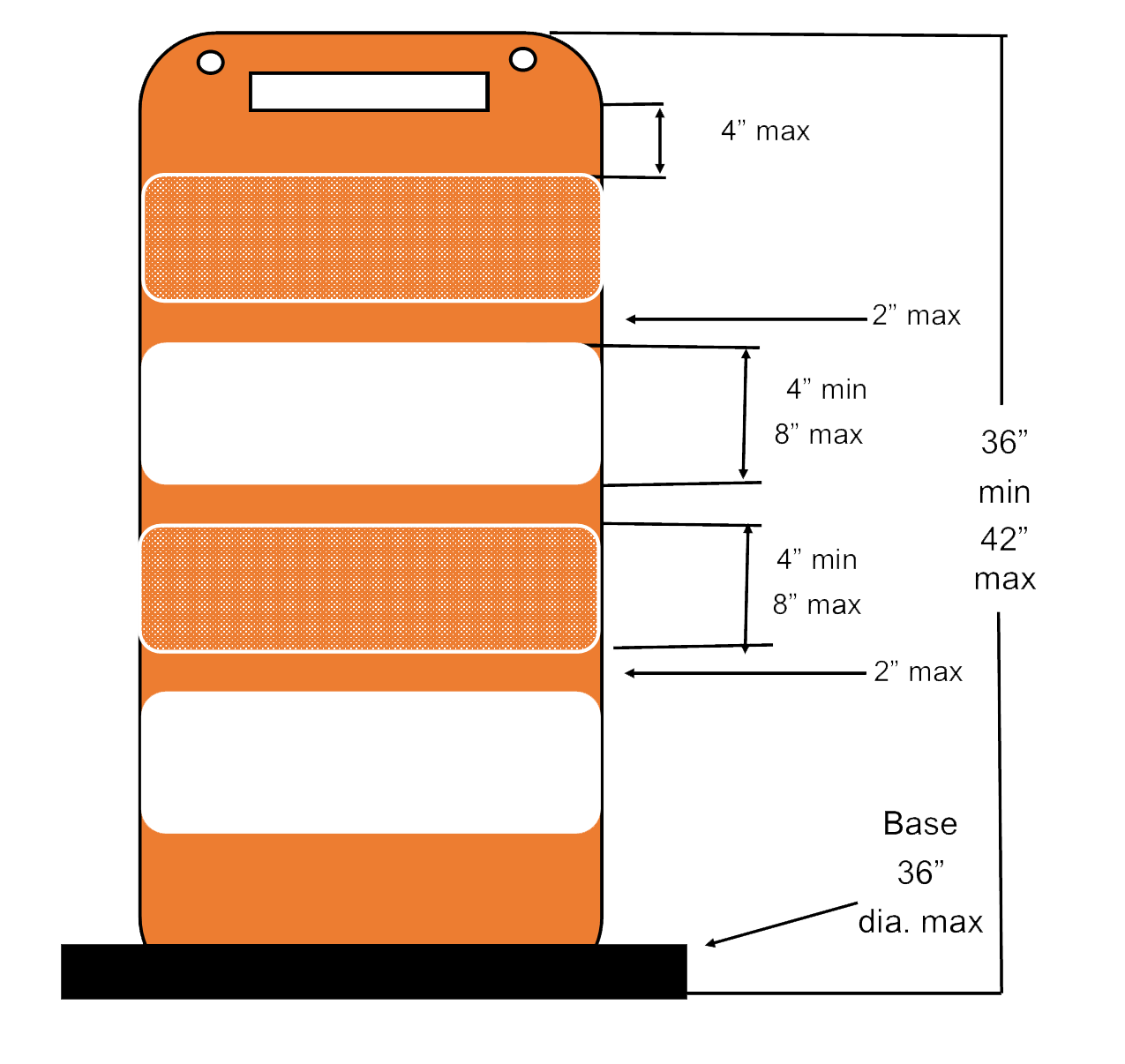
Drums
- Suitable for all duration work zone durations.
- Shall have a minimum of two orange and two white retroreflective stripes with the first stripe being orange.
- Metal drums shall NOT be used.
- Ballast shall not be placed on top of the drum.
-
Flagging
-
Worker Safety
-
PPE
Ears/Eyes/Hands/Boots
Personal Protective Equipment
The following is a general list of commonly needed PPE for transportation related maintenance and construction activities. Before starting a task, determine if PPE should be upgraded or added in order to work safely.
- Hard hat - add neck cover flap for summer use and enter liner for cold weather.
- Ear protection - ear plugs or ear muffs. Check Noise Reduction Rating (NRR) on hearing protection to find appropriate level of protection giving task being performed.
- Eye protection - safety glasses, goggles or face shields meeting or exceeding ANSI Z87.1-2015 standard.
- Safety Vests - ANSI Class II or III for night work (check inside label for safety rating).
- Steel toed boots - if working in wet conditions, consider slip resistant soles.
- Gloves - use the right style of glove for the right task.
- Dust masks / Respirators - in cases where dust, grass cuttings and/or tree chips are generated.
- Long sleeve shirts - protection against UV radiation/sunburn.
- Sun screen
-
Safe Work Practices
Heavy Equipment
SAFE WORK PRACTICES:
Heavy Equipment
The following is a general list of best practices when operating or working around heavy equipment.
- Only trained operators should operate equipment
- Read and follow operators manual
- Know capabilities/limitations of machine
- Use the right type of machine for the job at hand
- Complete pre-inspection checklist
- Ensure all utilities are identified and marked before digging
- Never smoke near or when operating the machine
- Never exceed posted load capacity or operating speed
- Always travel straight up and down slopes
- Look before backing - drive forward whenever possible and if backing use a spotter and/or honk horn. Be aware of blind spots.
- Use proper hand signals - and accept signals from only one designated person on the ground
- Never allow anyone to ride on equipment
- Never use cell phones or text while operating equipment
- Use 3 points of contact when mounting or dismounting - never jump off equipment
- Slowly warm up engine when starting work
- Allow engine to cool 5 min. before shutting down
- Remove keys and set parking brake
-
PPE
-
LTAP Resources
Quick Contact Information:
txltap@uta.edu
817-272-9678
- Tailgate Talks